
 Chinese
  French
  German
  English
  Spanish
  Hindi
Hindi  Italian
  Japanese
  Korean
  Norwegian
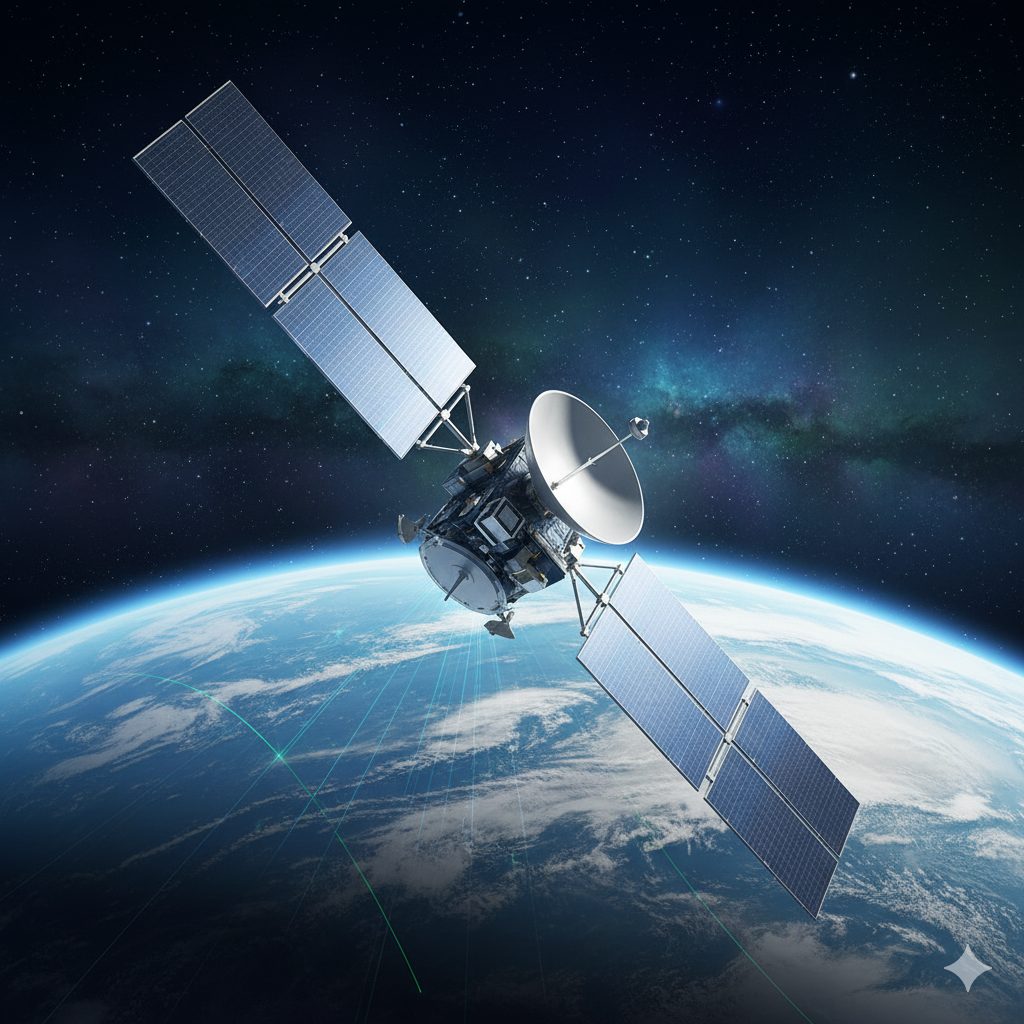
Sentinel-6B: Europe's New Guardian of Sea Level Rise
The European **Copernicus** programme takes a major new step with the successful launch of its latest ocean and climate observation satellite, **Sentinel-6B**. This eagerly anticipated launch by the scientific community ensures the continuity of crucial measurements for monitoring sea levels and studying climate change.
This satellite is the twin of Sentinel-6A, launched a few years ago, and its primary mission is to ensure **high-precision altimetric monitoring**. Space altimetry measures the distance between the satellite and the sea surface, which is essential for detecting even the slightest variations in ocean levels. This data is not only vital for climate research, but also for practical applications such as weather forecasting and maritime navigation.
Sentinel-6B does more than just measure ocean heights. It also provides detailed information on **significant wave height** and surface wind speeds. This multispectral capability considerably enriches the dataset collected by Copernicus, making it an unparalleled tool for environmental management on a global scale. Scientists will thus be able to refine ocean circulation models and future sea level rise projections.
The success of this mission is the result of exemplary **European collaboration**, involving the European Space Agency (ESA), EUMETSAT, NASA, NOAA, and CNES. Such an international partnership underlines the urgency and importance of concerted action in the face of global environmental challenges. The Copernicus programme thus positions itself as a pillar of European autonomy in Earth observation.
In conclusion, with the launch of Sentinel-6B into orbit, Europe reaffirms its leadership role in space climate observation. The data to be transmitted over the coming years will form an **invaluable resource** for political decision-making and the protection of our marine ecosystems. It is now crucial that this information is exploited to its full potential to inform climate change adaptation and mitigation strategies.



Sentinel-6B: Europe's New Guardian of Sea Level Rise
The European **Copernicus** programme takes a major new step with the successful launch of its latest ocean and climate observation satellite, **Sentinel-6B**. This eagerly anticipated launch by the scientific community ensures the continuity of crucial measurements for monitoring sea levels and studying climate change.
This satellite is the twin of Sentinel-6A, launched a few years ago, and its primary mission is to ensure **high-precision altimetric monitoring**. Space altimetry measures the distance between the satellite and the sea surface, which is essential for detecting even the slightest variations in ocean levels. This data is not only vital for climate research, but also for practical applications such as weather forecasting and maritime navigation.
Sentinel-6B does more than just measure ocean heights. It also provides detailed information on **significant wave height** and surface wind speeds. This multispectral capability considerably enriches the dataset collected by Copernicus, making it an unparalleled tool for environmental management on a global scale. Scientists will thus be able to refine ocean circulation models and future sea level rise projections.
The success of this mission is the result of exemplary **European collaboration**, involving the European Space Agency (ESA), EUMETSAT, NASA, NOAA, and CNES. Such an international partnership underlines the urgency and importance of concerted action in the face of global environmental challenges. The Copernicus programme thus positions itself as a pillar of European autonomy in Earth observation.
In conclusion, with the launch of Sentinel-6B into orbit, Europe reaffirms its leadership role in space climate observation. The data to be transmitted over the coming years will form an **invaluable resource** for political decision-making and the protection of our marine ecosystems. It is now crucial that this information is exploited to its full potential to inform climate change adaptation and mitigation strategies.
Sentinel-6B: Europe's New Guardian of Sea Level Rise
The European **Copernicus** programme takes a major new step with the successful launch of its latest ocean and climate observation satellite, **Sentinel-6B**. This eagerly anticipated launch by the scientific community ensures the continuity of crucial measurements for monitoring sea levels and studying climate change.
This satellite is the twin of Sentinel-6A, launched a few years ago, and its primary mission is to ensure **high-precision altimetric monitoring**. Space altimetry measures the distance between the satellite and the sea surface, which is essential for detecting even the slightest variations in ocean levels. This data is not only vital for climate research, but also for practical applications such as weather forecasting and maritime navigation.
Sentinel-6B does more than just measure ocean heights. It also provides detailed information on **significant wave height** and surface wind speeds. This multispectral capability considerably enriches the dataset collected by Copernicus, making it an unparalleled tool for environmental management on a global scale. Scientists will thus be able to refine ocean circulation models and future sea level rise projections.
The success of this mission is the result of exemplary **European collaboration**, involving the European Space Agency (ESA), EUMETSAT, NASA, NOAA, and CNES. Such an international partnership underlines the urgency and importance of concerted action in the face of global environmental challenges. The Copernicus programme thus positions itself as a pillar of European autonomy in Earth observation.
In conclusion, with the launch of Sentinel-6B into orbit, Europe reaffirms its leadership role in space climate observation. The data to be transmitted over the coming years will form an **invaluable resource** for political decision-making and the protection of our marine ecosystems. It is now crucial that this information is exploited to its full potential to inform climate change adaptation and mitigation strategies.