
 Japanese
  French
  German
  English
  Spanish
  Hindi
Hindi  Italian
  Korean
  Norwegian
  Chinese
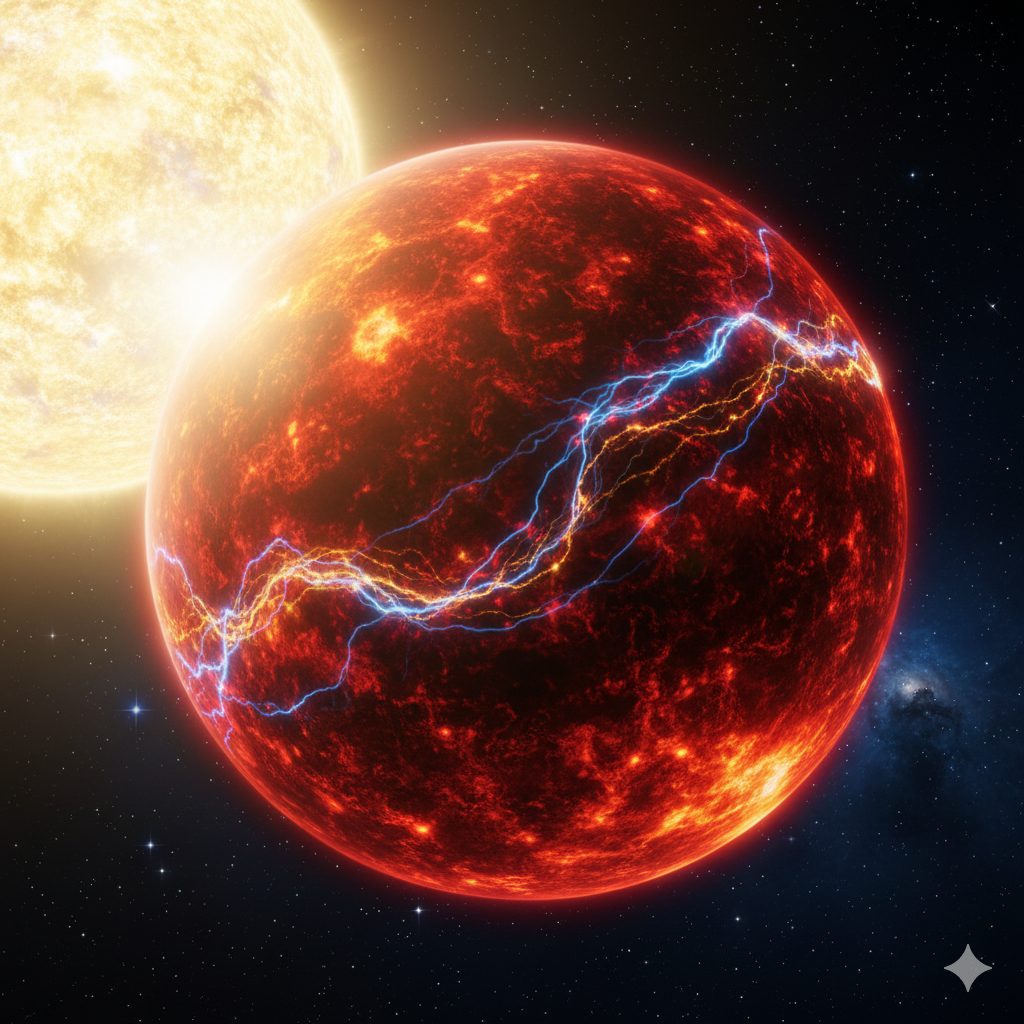
The Enigma of Exoplanet WASP-189b: Heavy Metals Defying Atmospheric Laws
Astronomy is in the spotlight this week with the exciting confirmation of a discovery that could redefine our understanding of planetary formation. Researchers from the Max Planck Institute for Astronomy have announced the detection of an unexpected, heavy-metal-rich atmosphere around an ultra-hot exoplanet, WASP-189b. This planet, already famous for being one of the hottest ever observed, continues to surprise us.
The key finding: The atmosphere of WASP-189b contains not only iron and chromium, as expected, but also clear signatures of Titanium and Vanadium, elements that should not persist so high in the atmosphere given the planet's extreme temperatures.
WASP-189b, sometimes nicknamed the "ultra-hot gas giant", orbits its star, HD 133131, in just 2.7 Earth days. Its proximity to its host star, larger and hotter than our Sun, pushes its surface temperature above $3200$°C, hot enough to vaporize rock. In such an environment, models predicted that heavy elements should quickly condense and fall back into the lower layers of the atmosphere.
The team, using the ESPRESSO instrument on the ESO Very Large Telescope (VLT) in Chile, was able to observe the planet as it transited in front of its star. This method allows scientists to analyze starlight filtered through the planet's atmosphere. The stable detection of these heavy metals at high altitude suggests that a powerful and still poorly understood atmospheric mechanism is at play. This could involve extremely strong winds or complex circulation processes that keep vaporized elements suspended.
This discovery is crucial. It offers new avenues for understanding how atmospheres resist or erode under intense stellar radiation. For future space missions, such as the James Webb Space Telescope, targets like WASP-189b are becoming privileged natural laboratories for testing the limits of our atmospheric physics. By studying these extreme worlds, researchers hope to unlock the secrets of planetary evolution, including, potentially, our own. The coming months promise new in-depth analyses to unravel the mystery of this molten atmosphere.



The Enigma of Exoplanet WASP-189b: Heavy Metals Defying Atmospheric Laws
Astronomy is in the spotlight this week with the exciting confirmation of a discovery that could redefine our understanding of planetary formation. Researchers from the Max Planck Institute for Astronomy have announced the detection of an unexpected, heavy-metal-rich atmosphere around an ultra-hot exoplanet, WASP-189b. This planet, already famous for being one of the hottest ever observed, continues to surprise us.
The key finding: The atmosphere of WASP-189b contains not only iron and chromium, as expected, but also clear signatures of Titanium and Vanadium, elements that should not persist so high in the atmosphere given the planet's extreme temperatures.
WASP-189b, sometimes nicknamed the "ultra-hot gas giant", orbits its star, HD 133131, in just 2.7 Earth days. Its proximity to its host star, larger and hotter than our Sun, pushes its surface temperature above $3200$°C, hot enough to vaporize rock. In such an environment, models predicted that heavy elements should quickly condense and fall back into the lower layers of the atmosphere.
The team, using the ESPRESSO instrument on the ESO Very Large Telescope (VLT) in Chile, was able to observe the planet as it transited in front of its star. This method allows scientists to analyze starlight filtered through the planet's atmosphere. The stable detection of these heavy metals at high altitude suggests that a powerful and still poorly understood atmospheric mechanism is at play. This could involve extremely strong winds or complex circulation processes that keep vaporized elements suspended.
This discovery is crucial. It offers new avenues for understanding how atmospheres resist or erode under intense stellar radiation. For future space missions, such as the James Webb Space Telescope, targets like WASP-189b are becoming privileged natural laboratories for testing the limits of our atmospheric physics. By studying these extreme worlds, researchers hope to unlock the secrets of planetary evolution, including, potentially, our own. The coming months promise new in-depth analyses to unravel the mystery of this molten atmosphere.
The Enigma of Exoplanet WASP-189b: Heavy Metals Defying Atmospheric Laws
Astronomy is in the spotlight this week with the exciting confirmation of a discovery that could redefine our understanding of planetary formation. Researchers from the Max Planck Institute for Astronomy have announced the detection of an unexpected, heavy-metal-rich atmosphere around an ultra-hot exoplanet, WASP-189b. This planet, already famous for being one of the hottest ever observed, continues to surprise us.
The key finding: The atmosphere of WASP-189b contains not only iron and chromium, as expected, but also clear signatures of Titanium and Vanadium, elements that should not persist so high in the atmosphere given the planet's extreme temperatures.
WASP-189b, sometimes nicknamed the "ultra-hot gas giant", orbits its star, HD 133131, in just 2.7 Earth days. Its proximity to its host star, larger and hotter than our Sun, pushes its surface temperature above $3200$°C, hot enough to vaporize rock. In such an environment, models predicted that heavy elements should quickly condense and fall back into the lower layers of the atmosphere.
The team, using the ESPRESSO instrument on the ESO Very Large Telescope (VLT) in Chile, was able to observe the planet as it transited in front of its star. This method allows scientists to analyze starlight filtered through the planet's atmosphere. The stable detection of these heavy metals at high altitude suggests that a powerful and still poorly understood atmospheric mechanism is at play. This could involve extremely strong winds or complex circulation processes that keep vaporized elements suspended.
This discovery is crucial. It offers new avenues for understanding how atmospheres resist or erode under intense stellar radiation. For future space missions, such as the James Webb Space Telescope, targets like WASP-189b are becoming privileged natural laboratories for testing the limits of our atmospheric physics. By studying these extreme worlds, researchers hope to unlock the secrets of planetary evolution, including, potentially, our own. The coming months promise new in-depth analyses to unravel the mystery of this molten atmosphere.