
 English
  French
  German
  Spanish
  Hindi
Hindi  Italian
  Japanese
  Korean
  Norwegian
  Chinese
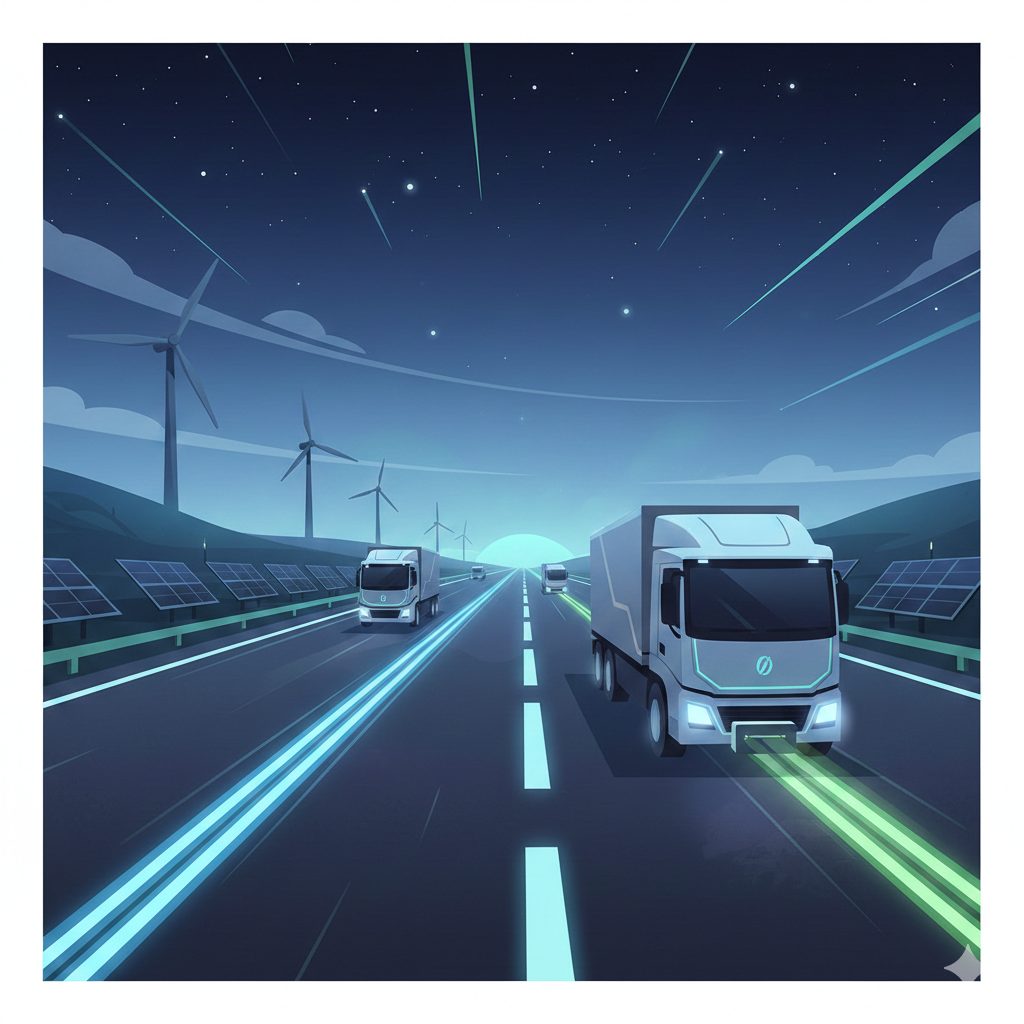
Electric Highways: The Wireless Charging Revolution Is Underway
This is a major milestone in the decarbonization of road transport. This morning, the first kilometers of a highway equipped with induction charging technology were officially opened, marking a historic turning point for sustainable mobility in Europe.
The challenge was immense: how to allow electric heavy-goods vehicles to travel long distances without depending on massive batteries and endless charging times? The answer now lies beneath the asphalt. Thanks to magnetic coils integrated directly into the road surface, energy is transferred wirelessly to the vehicle via a receiver located under the chassis. This system makes it possible to maintain or even top up the battery charge while driving at 90 km/h.
A Technological and Ecological Feat
This infrastructure, named "SmartRoad", does more than just supply electricity. It is coupled with an artificial intelligence system that optimizes energy distribution according to traffic flow and the needs of each vehicle. The goal is clear: reduce battery size by 40%, which would significantly lighten vehicles and limit the extraction of rare metals such as lithium and cobalt.
For freight operators, the benefits are also economic. Although the initial infrastructure investment is high, operating costs drop dramatically. Electricity costs less than diesel, and maintaining electric motors is simpler. Furthermore, eliminating prolonged stops at high-power charging stations enables optimal logistics flow, a compelling argument for an industry operating with tight margins.
However, questions remain about large-scale deployment. The cost per kilometer remains a barrier for many regions. Experts point out that this technology is especially relevant for high-density European transport corridors, where freight volumes justify the investment. France, Germany, and Sweden are already collaborating to standardize these systems and ensure interoperability of trucks across borders.
Towards a fossil-fuel-free Europe by 2040? This pilot project is, in any case, concrete proof that innovation can transform our roads into true vectors of the energy transition.



Electric Highways: The Wireless Charging Revolution Is Underway
This is a major milestone in the decarbonization of road transport. This morning, the first kilometers of a highway equipped with induction charging technology were officially opened, marking a historic turning point for sustainable mobility in Europe.
The challenge was immense: how to allow electric heavy-goods vehicles to travel long distances without depending on massive batteries and endless charging times? The answer now lies beneath the asphalt. Thanks to magnetic coils integrated directly into the road surface, energy is transferred wirelessly to the vehicle via a receiver located under the chassis. This system makes it possible to maintain or even top up the battery charge while driving at 90 km/h.
A Technological and Ecological Feat
This infrastructure, named "SmartRoad", does more than just supply electricity. It is coupled with an artificial intelligence system that optimizes energy distribution according to traffic flow and the needs of each vehicle. The goal is clear: reduce battery size by 40%, which would significantly lighten vehicles and limit the extraction of rare metals such as lithium and cobalt.
For freight operators, the benefits are also economic. Although the initial infrastructure investment is high, operating costs drop dramatically. Electricity costs less than diesel, and maintaining electric motors is simpler. Furthermore, eliminating prolonged stops at high-power charging stations enables optimal logistics flow, a compelling argument for an industry operating with tight margins.
However, questions remain about large-scale deployment. The cost per kilometer remains a barrier for many regions. Experts point out that this technology is especially relevant for high-density European transport corridors, where freight volumes justify the investment. France, Germany, and Sweden are already collaborating to standardize these systems and ensure interoperability of trucks across borders.
Towards a fossil-fuel-free Europe by 2040? This pilot project is, in any case, concrete proof that innovation can transform our roads into true vectors of the energy transition.
Electric Highways: The Wireless Charging Revolution Is Underway
This is a major milestone in the decarbonization of road transport. This morning, the first kilometers of a highway equipped with induction charging technology were officially opened, marking a historic turning point for sustainable mobility in Europe.
The challenge was immense: how to allow electric heavy-goods vehicles to travel long distances without depending on massive batteries and endless charging times? The answer now lies beneath the asphalt. Thanks to magnetic coils integrated directly into the road surface, energy is transferred wirelessly to the vehicle via a receiver located under the chassis. This system makes it possible to maintain or even top up the battery charge while driving at 90 km/h.
A Technological and Ecological Feat
This infrastructure, named "SmartRoad", does more than just supply electricity. It is coupled with an artificial intelligence system that optimizes energy distribution according to traffic flow and the needs of each vehicle. The goal is clear: reduce battery size by 40%, which would significantly lighten vehicles and limit the extraction of rare metals such as lithium and cobalt.
For freight operators, the benefits are also economic. Although the initial infrastructure investment is high, operating costs drop dramatically. Electricity costs less than diesel, and maintaining electric motors is simpler. Furthermore, eliminating prolonged stops at high-power charging stations enables optimal logistics flow, a compelling argument for an industry operating with tight margins.
However, questions remain about large-scale deployment. The cost per kilometer remains a barrier for many regions. Experts point out that this technology is especially relevant for high-density European transport corridors, where freight volumes justify the investment. France, Germany, and Sweden are already collaborating to standardize these systems and ensure interoperability of trucks across borders.
Towards a fossil-fuel-free Europe by 2040? This pilot project is, in any case, concrete proof that innovation can transform our roads into true vectors of the energy transition.